Level Crossings
Overview
Level crossings that work like the real thing - axle counters on the track, a control box, barriers, crossing lights, a bell, the monitoring signal and on-call crossings.
A CMR level crossing works like a German one: a train reaches a contact, the crossing lights show yellow, then red, and the barriers come down. As soon as the end of the train has cleared the crossing, the lights go out and the barriers open again.
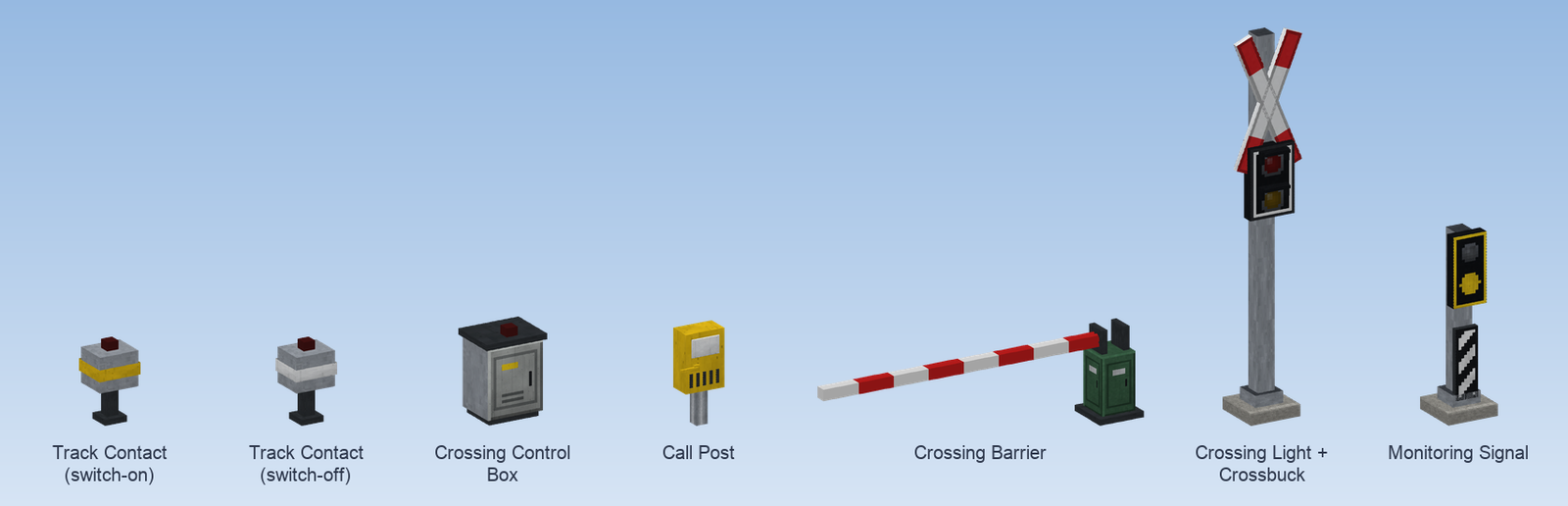
The parts at a glance
| Part | Job |
|---|---|
| Crossing Control Box | The brain: everything else is connected to it. |
| Track Contact | Axle counter at the rail: reports the train on its piece of track. As switch-on or switch-off contact. |
| Crossing Barrier | Barrier drive at the roadside with a moving boom. |
| Crossing Light | Black screen with red and yellow light for the road traffic. |
| Crossbuck | The St Andrew's cross, on top of the mast. |
| Crossing Monitoring Signal | Tells the train driver that the crossing ahead is secured. |
| Call Post | For an on-call crossing: road users ask the signal box to open it. |
| Connection Cable | Connects contacts, barriers, lights, signals and call posts to the control box. |
All parts sit together in their own creative tab, Level crossing, together with the Bü signs.
How it runs
- A train runs over a switch-on contact.
- The crossing lights show yellow for the warning time (3 seconds by default); the barriers stay open.
- Then red, and the booms come down.
- When the end of the train has left the crossing (the switch-off contact), the red goes out and the barriers open at once.
The crossing is pure safety for road users and players. It does not stop trains. The monitoring signal only tells the
driver whether the crossing is secured.
The signs that belong to a crossing (Bü 2 diamond board, Bü 4 whistle board, Bü 5 bell board and more) are in the Bü Sign; see Sign boards.