Gangways
A Gangway joins two cars of a train into one walkable passage. On the train it stretches to the gangway of the next car, bends with it in curves, and you walk across on the gangway plates.
Two kinds
| Kind | Prototype | Looks like |
|---|---|---|
| Bellows | ICE, IC2, multiple units | A closed tunnel of folded rubberised fabric, dark outside and light inside. |
| UIC rubber roll | Classic coaches | A short canvas bellows with a frame and a black rubber roll; the rolls of both cars meet in the middle. |
Create's wrench switches the whole passage between bellows and rubber roll ("Gangway: bellows", "Gangway: UIC rubber roll").
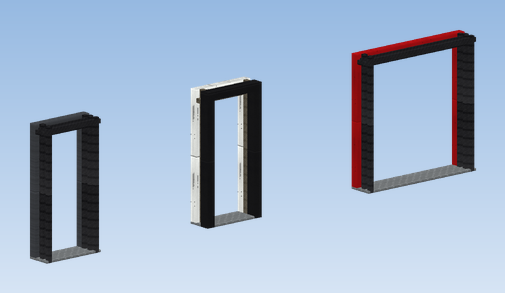
The frame comes in three colours, each its own block: Gangway (black), Gangway, light grey and Gangway, traffic red.
Building a gangway
Place it from inside
Set the gangway cells into the end wall of the car while standing inside the car and looking out.
Make it as large as you need
Cells beside and above each other join into one passage of any size: one wide and two high fits a door, three by three suits a wide car. A cell placed next to another takes over its direction and kind. The frame runs only round the edge of the whole passage.
Do the same on the next car
The neighbouring car needs its own gangway facing this one.
Assemble the train
On the train each gangway reaches to the gangway of the next car that faces it, up to 4 blocks away. It is drawn in one piece, and players walk through.
Good to know
- At the end of the train, or with no partner within 4 blocks, the gangway stays folded.
- What counts is the direction the gangway block faces, not how the car is built. Both gangways must look at each other.
- Gangways can be rotated with WorldEdit and similar tools.
- Gangways placed with a version before 0.4.0 lose their joins to the left and right. Break one cell and place it again, and the passage joins up.