Masts and mounting
A light signal can stand on a mast, sit on a wall, hang from a ceiling, stand diagonally or hang from a signal gantry. Where it goes is decided by where you place it; there is no setting for it.
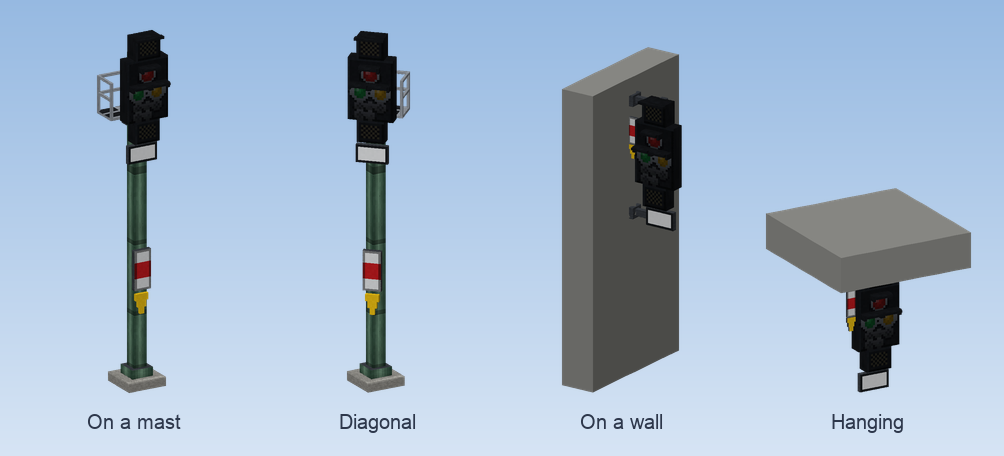
Signal mast
The Signal Mast stacks to any height. It sets up two things by itself:
- The lowest piece gets a concrete foundation.
- Below a light signal the mast carries that signal's mark, facing the same way:
| Signal | Mark on the mast | Where |
|---|---|---|
| Main signal (Ks, H/V, Hl) | mast sign white-red-white | second piece from the top |
| Ks combined signal | mast sign white-red-white with yellow triangle | second piece from the top |
| Distant signal | distant signal board (Ne 2) | second piece from the bottom |
| Semaphore main signal | none |
So a mast needs at least two pieces for the mast sign to show, and a distant signal looks right with three or more.
Mast styles
Right click the mast with Create's wrench (management right needed) to cycle the style of the whole mast, including the signal on top:
| Style |
|---|
| Mast: tubular, green |
| Mast: tubular, galvanised |
| Mast: tubular, black |
| Mast: lattice |
A new mast piece and every signal you put on top (light signal, crossing light, crossbuck, monitoring signal, sign boards, railway lamps) take over the style of the mast and carry it on under their head.
On a wall
In tunnels, cuttings and halls a signal can sit on a wall beside the track, without mast. It is mounted on the wall by itself when
- there is a solid block to the left or right of the signal and no signal mast below it, or
- you place it directly against the side of a solid block.
The wall runs along the track: the signal faces the trains and the wall is beside it. A support rail behind the screen carries screen, indicators and plate, and two arms reach to the wall. There is no mast and no maintenance platform; the mast sign sits beside the screen.
Hanging
Place the light signal against the underside of a block. It then hangs from a ceiling plate (or directly from its speed indicator), without mast.
- It is built from the top down: switch an indicator off and everything below moves up, so the signal gets shorter.
- The mast sign sits to the left of the screen. A distant signal carries the yellow triangle there instead of the distant signal board (allowed by the signal book, Ne 2).
- An H/V main signal with distant signal holds the distant screen below on a hanger.
- Under the beam of a signal gantry it hangs in a frame with a maintenance platform; see Signal gantries.
Diagonal
Light signals, masts, sign boards, speed boards, railway lamps and all parts of the level crossing can also stand turned by 45 degrees, to match diagonal track. There is no extra step: they face you when you place them, so stand diagonally to the track when you place them.
Signal systems
Besides Ks, the light signal can be an H/V light signal, an Hl signal of the former DR or a semaphore signal with moving wings.
Signal gantries
Build signal cantilevers and signal bridges from columns and beams, with climbable ladder, back guard and walkway, and hang or stand light signals on them.