Signal systems
The Light Signal comes in eleven types, picked under Type in its settings (right click with Create's wrench). They all connect to a Create signal in the same way, use the same name plate and limit trains the same way; see Light signal. This page explains how the other systems show their aspects.
| System | Types |
|---|---|
| Ks | Ks combined signal, Ks main signal, Ks distant signal |
| H/V (light) | H/V main signal, H/V distant signal, H/V main and distant signal |
| H/V (semaphore) | Semaphore main signal, Semaphore main, 2 wings, Semaphore distant signal |
| Hl (former DR) | Hl main signal, Hl distant signal |
H/V light signals
The older system of the Deutsche Bundesbahn: the main signal (Hp) and the distant signal (Vr) have screens of their own.
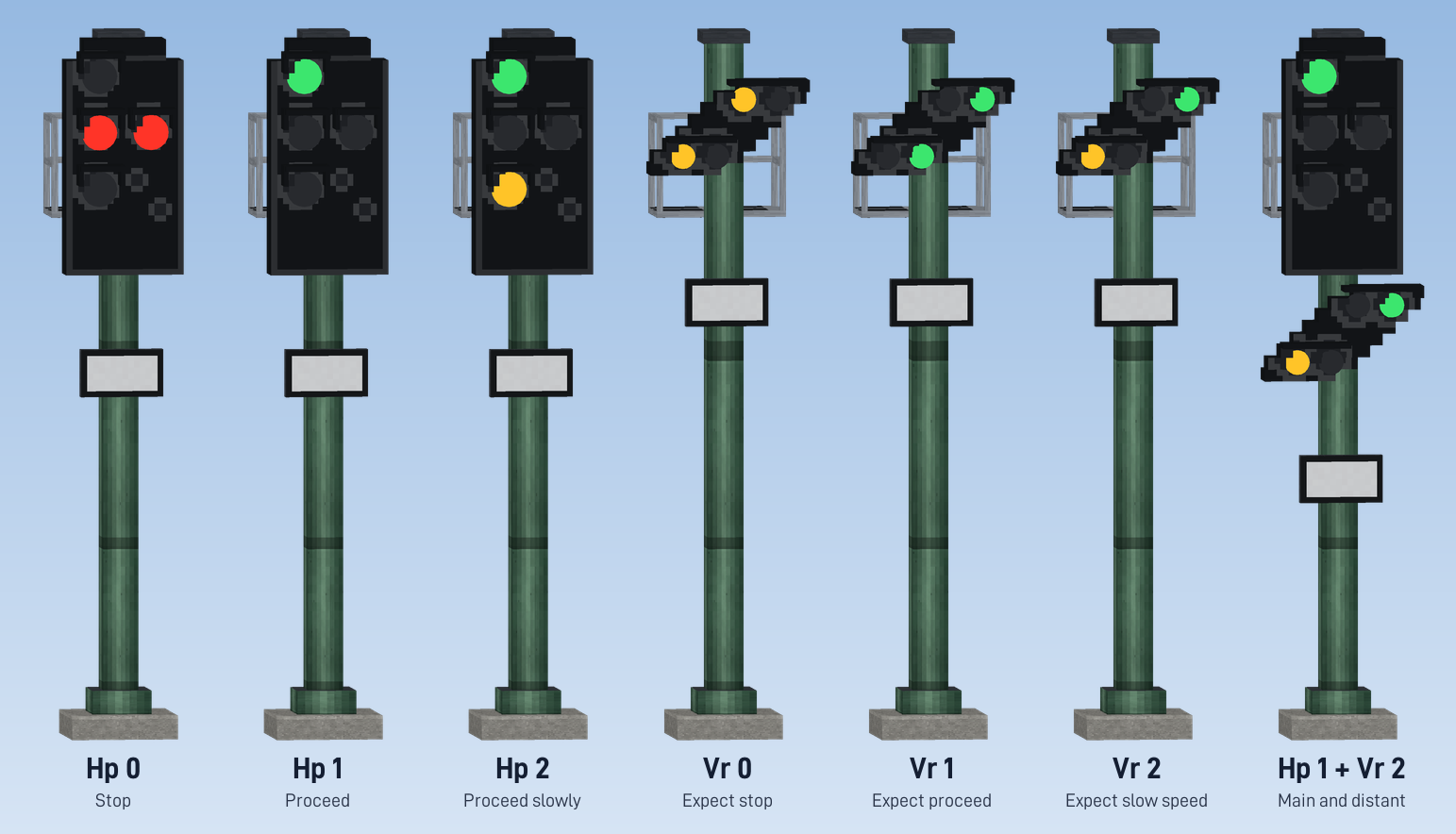
| Aspect | Lights | Meaning |
|---|---|---|
| Hp 0 | two red | Stop. |
| Hp 1 | green | Proceed. |
| Hp 2 | green over yellow | Proceed at reduced speed. |
| Vr 0 | two yellow, rising to the right | Expect stop. |
| Vr 1 | two green, rising to the right | Expect proceed. |
| Vr 2 | yellow and green | Expect reduced speed. |
- Hp 2 or Zs 3: with a Zs 3 digit up to 6 the main signal shows Hp 2; with a higher digit it shows Hp 1 and the digit on the speed indicator. The distant signal does the same with Vr 2 and the Zs 3v digit.
- H/V main and distant signal: the distant screen sits on the mast below the main screen. It stays dark while the main signal shows stop, as the signal book requires.
- The extra light of an H/V distant signal sits above its left light and lights at Vr 0 and Vr 2.
Hl signals
The light signals of the former Deutsche Reichsbahn show the speed in the lamps themselves instead of with Zs 3. An Hl signal therefore has no Zs 3 or Zs 3v boxes.
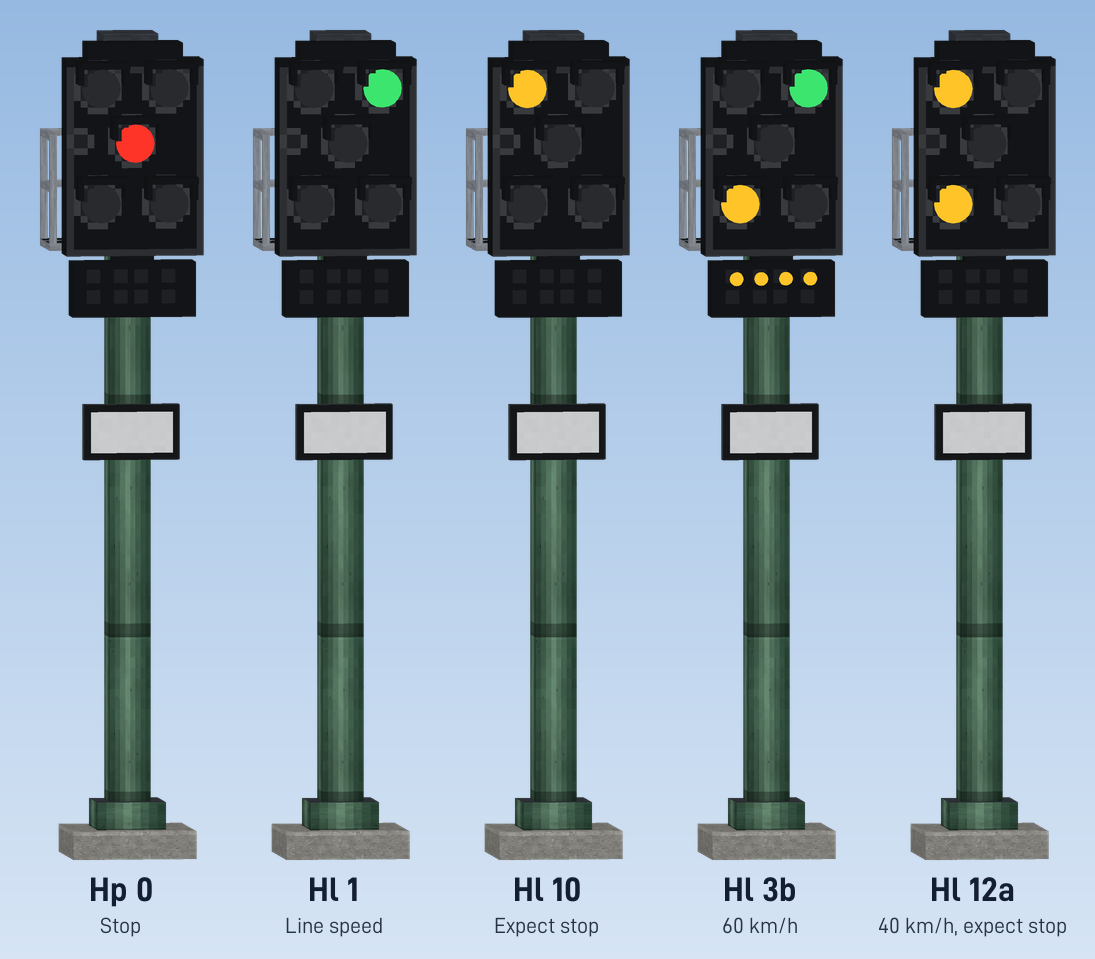
The screen has two parts:
- The upper light announces the speed at the next signal: green (line speed), green flashing (100 km/h), yellow flashing (40 or 60 km/h), yellow (expect stop).
- The lower light and the light strip give the speed from this signal: dark (line speed), yellow (40 km/h), yellow with yellow strip (60 km/h), yellow with green strip (100 km/h). Red in the middle is Hp 0.
| Lower light → / upper light ↓ | line speed | 100 km/h | 40 km/h | 60 km/h |
|---|---|---|---|---|
| green | Hl 1 | Hl 2 | Hl 3a | Hl 3b |
| green flashing | Hl 4 | Hl 5 | Hl 6a | Hl 6b |
| yellow flashing | Hl 7 | Hl 8 | Hl 9a | Hl 9b |
| yellow | Hl 10 | Hl 11 | Hl 12a | Hl 12b |
In the settings you pick:
| Setting | Choices |
|---|---|
| Speed from this signal | Line speed (lower light dark, lifts a limit), 100 km/h (limits trains to 90 %), 60 km/h (60 %), 40 km/h (40 %). |
| Speed at the next signal | Line speed (green), 100 km/h (green flashes), 40 or 60 km/h (yellow flashes). |
"Expect stop" (yellow) is not a setting: it comes from the next signal, when it shows stop. The Hl distant signal has only the upper light and shows Hl 1, Hl 4, Hl 7 and Hl 10. Digits from a Display Link or the signal box are rounded to the nearest speed of the system.
Semaphore signals
Semaphore signals of the H/V system: wings and a disc that move with the aspect, and lights behind coloured glass at night.
| Type | Day | Night | Aspects |
|---|---|---|---|
| Semaphore main signal | one wing: horizontal at stop, raised at an angle for proceed | red, green | Hp 0, Hp 1 |
| Semaphore main, 2 wings | the second wing is raised along for Hp 2 | red, green, green over yellow | Hp 0, Hp 1, Hp 2 |
| Semaphore distant signal | yellow disc and additional wing | two yellow, two green, yellow and green | Vr 0, Vr 1, Vr 2 |
- A semaphore main signal carries no mast sign; in the signal book only light signals have one. The semaphore distant signal gets the distant signal board on its mast.
- A semaphore has no light box for Zs 3. Its digits are still set in the settings (Speed Zs 3 and Announced speed Zs 3v) and still count: digit 1 to 6 gives Hp 2 (both wings up) or Vr 2 (wing slanted), and the train is limited as with any light signal. To show the digit, put a Zs 3 board (Zs Signal, "Zs 3: Speed Indicator (board)") on the mast.
Light signal
The big German Ks signal for a Create signal - placing it, connecting it, its aspects, the Zs 3 speed limit, the name plate and the distant signal line.
Masts and mounting
Signal masts and their styles, the mast signs they set by themselves, and light signals on a wall, under a ceiling or turned diagonally.